 Georgia Arts Initiative
Inside the Casting Room with Clifton Guterman: What Actors Need to Know After They Hit Submit
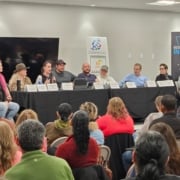
This is the official recap of Georgia Arts Initiative’s September Industry Talk, Behind the Casting Process, hosted by Kelly Young-Silva, President of Georgia Arts Initiative and owner of Words In Motion Acting Studio, with CSA Casting Director Clifton Guterman.
On September 9, actors, parents, teachers and industry professionals joined the conversation to ask Clifton real questions about what happens after an actor hits SUBMIT. Below are some of the questions asked in the room and the insight Clifton shared from the casting side of the table.
Kelly Young-Silva asked: What happens to the tapes?
Kelly opened with the question actors wonder about after every self-tape: Does casting actually watch all of them?
Clifton explained that in his process, he watches auditions as they come in and rates them using an A, B and C system. An A is someone he can see working for the project and may move forward as a finalist. A B may be close but need an adjustment or may not be the strongest fit yet. A C may simply not be right for that project or may still need more training.
From there, he typically gives the creative team roughly 15–20 strong options for a role. If the project is doing callbacks, he may recommend narrowing that group to around five people. Sometimes a team may make an offer, sometimes request a callback, and sometimes ask for a retape with a specific note.
Reed Willard asked: Does submitting early give you an advantage?
Reed asked one of those questions actors debate constantly: if an audition arrives Monday and is due Friday, does the actor who submits first have an advantage?
Clifton said he does watch tapes as they come in, and yes, casting can begin to fall in love with strong tapes early. But he was very clear about the larger point: do not rush an audition just to be early.
He has seen tapes arrive quickly that were obviously underprepared. He has also seen last-minute tapes that looked thrown together. His advice was to submit when the work is ready — prepared, polished, specific and professional.
Being first does not rescue an undercooked audition.
Steven Lowe asked: Does the audition begin with the slate?
Steven asked about slates and electronic readers.
Clifton told us that in his own casting process, he generally asks for the slate as a separate file and watches the scene first. He does not want a stiff or awkward slate to bias him before he sees the acting. For him, the first impression is the opening beat of the scene — the moment before, the character and the story.
Steven also asked about electronic readers. Clifton acknowledged that the technology has improved, but the issue is whether anything pulls casting out of the storytelling. Lag, artificial timing, tinny sound, distracting backgrounds, poor lighting or anything else that interrupts the scene can chip away at the viewer’s ability to stay inside the work.
The tape does not have to be technically perfect. But the technology should not get in the way of the acting.
Richard Plummer asked: What makes an audition an “A”?
Richard brought the conversation back to Clifton’s A, B and C system and asked what makes an audition look like a finalist.
Clifton described an actor who is physically appropriate for the role, makes specific choices, recognizes the beats in the writing, understands eyeline, sizes the work for camera and clearly understands who is on the receiving end of the scene. The actor’s objective, obstacles and actions should be evident in the work.
Then came a point actors should underline: if casting asks for two takes, do not send the same performance twice.
The character’s objective may stay the same, but the action can change. If Take One pursues the objective through pressure or confrontation, Take Two might use charm, humor, flirtation or another genuinely different tactic. That is what makes the second take useful. It shows range.
Natalie and Maurice asked about raising a young actor
Natalie and Maurice asked what advice Clifton would give parents of a young actor entering the business.
His first answer was beautifully simple: they are kids first.
Let them have kid days. Let them go to school. Let them play. Do not make every audition feel like an obligation. Sometimes the schedule does not work. Sometimes the child is exhausted. Sometimes the material is not right. Sometimes the answer is simply no.
Clifton spoke from his own experience as a parent of a young actor. His philosophy is that he never wants his child to feel forced to perform or to lose the fun of storytelling.
Know your kid. The career should not swallow the childhood.
Kennedy Crawford asked about boundaries
Kennedy asked an important professional question: if a role requires nudity and an actor already knows that is outside their boundaries, should they audition anyway and explain the limitation later?
Clifton’s advice was to be clear before the offer stage. If you know you cannot or will not do something the role specifically requires, auditioning for it can waste your time and casting’s time — and can create a much harder problem after a creative team has already fallen in love with the tape.
If something in a breakdown is unclear, ask. That can include nudity, intimacy, smoking, violence, weapons, prosthetics, food requirements or other material that may affect whether you can actually accept the job.
Actors need to know their boundaries, communicate them and ask questions before everyone gets to set.
The thread running through the whole conversation
Different people asked different questions, but the answers kept circling the same idea: the work has to tell the story.
Do not race to submit at the expense of preparation. Do not let the technology become more noticeable than the acting. Do not send two identical takes and call it range. Do not ignore your boundaries because you are afraid to ask a question. And when you are working with a young actor, remember there is a child before there is a résumé.
Near the end of the afternoon, Clifton talked about how much he genuinely loves actors and about the shared goal between actors, casting, directors and crew: great storytelling.
Kelly Young-Silva
President, Georgia Arts Initiative
Owner, Words In Motion Acting Studio
About Clifton Guterman
Clifton Guterman is a CSA Casting Director, actor and educator based in Georgia. During the talk, he shared his journey from growing up in Iron City, Georgia, to acting, teaching and working on the other side of the casting process. Learn more at CliftonGutermanCasting.com.
6287 Fairburn Road, Douglasville, Georgia
 Jan 2024